Wednesday, June 10, 2015

Golden Arches?


What’s your ‘happy meal’ when its comes to a trail race? The parts that make up the whole. Do you run a particular race for the course, the medal, the vibe, the ‘eat your weight’ aid stations or the hullaballoo?

The trail running explosion has ensured that trail races are now as glitzy and varied as their road counterparts. This grates with some runners who prefer the old style, no hype, just pitch up and run variety, where every aid station wasn’t a cacophony of cowbells and a buffet table of edibles. Social media has ensured that you can also follow the exploits of your favorite mountain goat live through twitter, facebook and live feeds. www.irunfar.com do a stellar job of broadcasting the sport to it's followers as well as previewing every significant race on the calendar (in US and Europe anyway). This brings attention to the sport, the elites and also companies with products that we all use.

If trail running, and your ability at it, gives you the (free) opportunity to travel to far off places, at a sponsor’s expense, should you complain when said sponsor is trying to maximize their exposure at races? Trail runners and organizers are almost all zealously concerned about impact on the environment. Some insist on no cups or plastic sashes, zero impact on the environment, many insist on a number of trail maintenance days BEFORE you can even run the race.

These are all great positives for the sport and its participants. Most of the companies involved in trail running are passionate about the sport and appreciate the relatively small return on investment from the minimal exposure from race coverage. Lets face it, this isn’t prime time, media circus stuff.

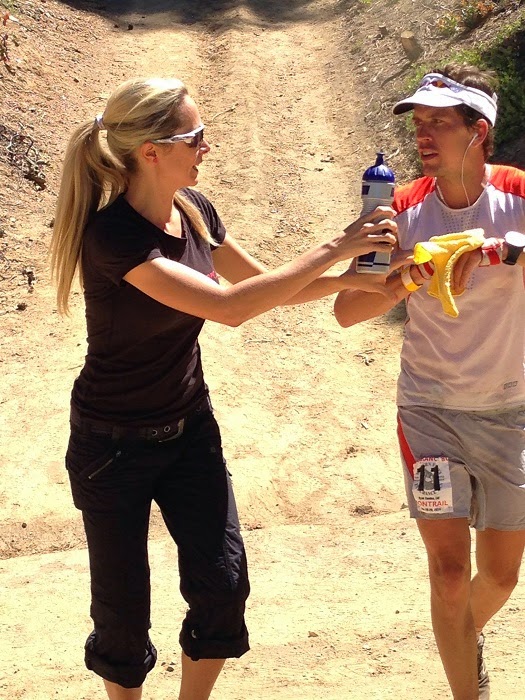
Interviewing Jeff from the Animal Athletics cheering station at the Gorge ultras
So have races got too big and does it detract from the sport? Way to Cool, a 50k trail race in California attracts 1000 runners for one distance over one course on one day. There’s a start arch, and a finish village with chill out zones and the like, giving it a festival feel. The Squamish 50 has a 50 miler, 50k, 50/50 (both 50 miler AND 50k), 23km, kids run and a film fest! That’s 1100 runners over two day on technical, beautiful trail in British Columbia, Canada. There are also orientation runs pre-event on the course. That’s a lot of hype.  But it also brings together a whole lot of like-minded people, many of them new to trail running, to celebrate what they love doing; running on trails. For those of us not present we can (at most races) read about and be inspired by those killing it at the front and follow them via twitter and other social media. That keeps us connected (if Mark Zuckerburg is to be believed) and inspires us to our own less lofty goals. The elites in return receive sponsorship, products, trips to overseas races and the chance to live a dream.  The nirvana of melding your passion with your vocation is attainable for those of us who work in the outdoor industry or are sponsored athletes. We are lucky. Personally I’m prepared to pay the price of increased exposure and commercialization to be able to work in an industry that benefits, but also supports the outdoors.

Chill out zone at the Way Too Cool 50k
Race organisers mostly agree that a splattering of hype is good for runners. Todd Janssen of Portland, Oregon based Go Beyond Racing (www.gobeyondracing.com) says he’s all for providing information and entertainment for runners and supporters; “I wouldn’t dream of putting on a race without doing live updates, if it’s possible at the race. To me it’s the new normal.” Giving value to often hard earned sponsorships is also important, Todd says. "Sponsors definitely appreciate the social updates, but don't think that it's necessary to only do them during the race. I think updates leading upto and after the event are also effective from a sponsor's perspective." 
Jeff Fisher and the 'winner' of the canine race
But it is a sport and a hobby, so you CAN choose, not just to race or not (99% of trail race courses are open to trail runners 365 days a year for free!), but also between those races who’ve kept it simple and those with a healthy dose of razzmatazz.

Hyped up or suffering from hyper tension?

A race’s facebook page is a good indication of the hype meter.; five followers and no update since 2012 is one for the hyper tense.

Did you get offered a t-shirt, mug, VIP pass and lucky draw for your OWN portaloo when entering? One for the hyped up for sure.

Hand written race number the size of a postage stamp? Good to go for the hyper tense.

A menu of aid station nutrition on the website? Another for the hyped up.

Results posted on a tree? Old school vibe.

Prize for the first canine? Head for this hype city.


Friday, November 21, 2014

What the F*KT?

Do you know what an FKT is? I didn’t until recently. In South Africa they weren’t common place until Ryan Sandes and Ryno Griesel demolished the best time for the Drakensberg Traverse. Ie the ‘Fastest Known Time’ for that route. Here in the good old US of A, the home of long distance trail running they are sought after, documented and even debated in depth on a website http://fastestknowntime.proboards.com/

Maybe an FKT is a Strava for grown ups? Those of us using Strava to document our regular training runs are familiar with trying to run a certain trail the fastest, or at least comparing our time with our peers. FKTs here seem to have a certain appeal to a certain runner. There’s definitely an element of chest thumping (although female FKTs are also on the increase) but also a desire to just go out, alone, unsupported and run a trail, whenever.

My Wildwood end to end FKT 'attempt'
Here in Portland we have Forest Park, the 5000 acres of natural wilderness actually IN the city and containing the Wildwood Trail; 30 miles of uninterrupted trail from the city stretching north. To a South African trail runner used to rocky technical trails, Wildwood would be akin to running on a cricket pitch. Manicured, well maintained and un-technical in the extreme. But it is single track the whole 30 miles which is pretty special. It twists and turns through densely wooded forest for a distance that is only 9 miles in a straight line. It is home to deer, coyote, raccoons, allegedly (feline) cougars. When I arrived in Portland I ran on sections of it, and heard more about the end to end run, or even the end to end to end run (60 miles obviously). Eventually and inevitably I was drawn to run the whole trail unsupported, which is how most short FKTs are run.

The view from Wildwood at Pittock Mansion
My plan was to run South to North meaning you start literally downtown and run out, watching the number of hikers, dog walkers and runners dwindle. I carried water and gels for the relatively short time on my feet. My target was the current FKT of 3.38.16 for the 30.25 miles by local legend Yassine Diboun, which didn’t seem out of the question for 30 miles of relatively tame undulating trail.

As I started out on a crisp cool morning I was confident I could get near the FKT. I topped the only significant climb to the historic Pittock Mansion and felt good. As I left the busier parts of the park the miles ticked away (each ¼ mile is marked on a tree with a blue diamond and the distance from the start). But this trail doesn’t bite you, it knaws away at you, the rollers are endless, the twists and turns make finding a rhythm difficult and suddenly your pace has slipped. The twisting single track all looks the same and the blue diamonds aren’t slipping by so fast. I stopped once or twice to take a gel or have a pee, but mostly I plodded rather than ran the last 10 miles or so. I purposely didn’t look at my watch until a mile of so to go and was shocked to see HOW far I was not only outside the FKT, but also my ‘worst case’ time of a sub 4 hour run. I arrived at the end of the trail in 4.12.24, well outside the FKT.

And then it was done
This really was FKT lite, and better runners are attempting more extreme FKTs literally weekly. Those to stare in awe at are Killian Jornet’s Matterhorn FKT, Rob Krar’s Grand Canyon Rim to Rim to Rim record (now likely to stand for all time as national parks have tightened up on solo traversers) and a recent attempt on the 2175 mile Appalachian Trail speed record of 46 days. That’s 47 miles a day. Every day. For over 6 weeks! Karl Meltzer, the winning most 100 miler was last seen on day 32 and appears to have abandoned an attempt at this insane record.

You want to run a FKT?

Decide which record; unsupported (you carry all your own shit). Self Supported (you can stash shit on the route in advance). Supported (everyone else carries your shit)

Find a route that has an FKT within your compass

Post that you are going to attempt it on www.fastestknowntime.proboards.com           

Run with a GPS to record the time, distance and route

Tell your family and friends your intention (makes it easier for everyone to believe you)

Shout ‘go’ as you run off into the distance

For inspiration watch Killian on the Matterhorn https://www.youtube.com/watch?v=vAeHysSVMUk

Go do it!

Thursday, September 11, 2014

Tales from a Pacer


From my TRAIL magazine South Africa column.....

The mission was straightforward; pace one of the World's best trail runners for the last 20 miles of the 100 mile Western States (WS) trail race, the big daddy of trail racing, and one all ultra trail runners dream of. 
Happy crew WS T-1
South Africa's Ryan Sandes went into WS with a Drakensberg Traverse record, a European trail race win and a Japanese second place. Along with Rob Krar, last year's ultra runner of the year, he was the favourite, but a 100 miles is a long way. 

At Western States most of the top runners have crew and pacers. Pacers are allowed to accompany a runner from the 62 mile mark at Foresthill to the finish. I was due to jump in at the 80 mile mark.

Surely having run 80 miles I would be able to do the job and keep pace with Ryan? Pacers have been allowed at ultras for a while, in theory to provide safety for the runner should he or she get into trouble. In reality with only 5 miles between aid stations, the pacer is more a companion and a cajoler, encouraging their runner when spirits and energy dip. You can expect to talk without reply, crack your best jokes without so much as a polite laugh and tell your man, in true Bruce Fordyce fashion, that he's running like a star, when 80 miles into a race shuffling like Ali is more the reality.

Vanessa crewing Ryan at WS
80 miles at Western is Green Gate, which is, well a nondescript green metal gate. When Ryan arrived at 5.30pm with the temperature gauge tipping 30 degrees he DID look great, at least compared to the other four runners who had gone through. We were 5th and it was game on!

But ultra trail runners have toughened up in recent years and as hard as we ran (mostly around 5 minutes a kilometre) there were no ‘big blows’ in front of us. Every split we received told us we weren’t making inroads. Then on a 5km downhill section Ryan decided to inflict damage on his quads and he flew. The 10 minutes to the fourth placer Max King reduced to a visible 30 seconds with just 3 miles to go and we were hunting.

We run straight through the aid station at No Hands Bridge at 96.8 miles and flew after Max, passing him on the gradual climb to Robie Point. But Max is no quitter, and we couldn't gap him. Ryan was spent and I was paying for lack of training and 1000m of climbing in 30k. He dropped me. Ryan was moving, I wasn't. Pacers have been dropped before by lead runners, but it is a pretty humbling badge of shame to walk and jog in to the finish, past the spectators who are well informed enough to know what has occurred. 

Max surged past Ryan again, who had to be content with an excellent 5th overall in 15 hours 46 minutes.

Ryan getting the cooler treatment at Green Gate
Over the next 14+ hours I stayed at the finish line in Placerville High School and watched the other 291 finishers trail in before the 30 hour cut off. 100 miles may be a long way, but to run for 30 hours through two sunrises seems a very long time. Emotions are high when you have conquered that distance, in dry, relentless heat over two days, and those finishing in the hour prior to the cut off receive Comrades like encouragement as they complete the last 300 metres on the school track. Unlike Comrades you are likely only to have your family at the finish to cheer you in.

Want to run the Western States?

As an overseas entrant you may get 'special consideration'. The guidelines seem vague but it beats entering the lottery where your chances are 1 in 10.

You still need to run a 100k race in under 16 hours, or finish a 100 miler in anytime to qualify.

Do plenty of downhill running. The course is always a 'down run' from the highest point just after the start at the Squaw Valley ski resort at 2656m to the finish in Auburn at 394m.

BUT you still do almost 5000m of climbing over the 100 miles. 

Have a good crew. Although the aid stations are well stocked, a friendly face every so often makes a difference.

Have a good stomach. Many ‘drops’ are due to stomach issues from too much sweet stuff.


Check out all the details at www.wser.org

TRAIL magazine is available digitally;

apple

magzter

zinio 

Tuesday, April 1, 2014

Gender Bender

There are relatively few sports where men and women line up on the start line together and even fewer where they are competing for the same prize. Equestrianism is the highest profile example, with women competing and beating men in show jumping, three day eventing and flat and jump racing. No adjustments are made, they have to be as strong, as brave and as dedicated as their male counterparts.

In running, women almost always line up with men, but race within their sex. It's pretty recent history when women weren't 'allowed' to race over the same distances as men, and running in marathons and further was more than frowned upon.

Thankfully views have changed, and barriers have been removed. In professional sport, prize money is more often than not at parity, although again, this is a very recent change. It sends out all the right signals about equal opportunity, promoting the sport and enabling women to make a living at doing something they love. Something men have had the privilege of doing for much longer.

But it is early days, and what didn't strike me, until I started writing this post, was how few women appear in TV commercials here promoting brands and products. Whilst that's hardly evidence based it does demonstrate how few women are instantly recognizable in sport. Or maybe it indicates they aren't prepared to sell their soul for a pizza. I would :)

Two Oceans prize money equal for both sexes
What got me thinking was our beloved trail running, and an upcoming race that is offering apparently the biggest prize purse in South African trail running. Great news for the sport if it has aspirations to grow, be recognised nationally and internationally, receive increased media coverage and therefore attract more and better runners to the sport.

A typical WP road race - again no gender distinction
The problem? This is a team event, with two runners in a team, both who have to finish each day's stage (its a three day race) together. Winning men's team R15,000, winning mixed team R15,000. Winning  women's team R5000. The first women's team receives a THIRD of that of the men's and mixed teams. If I was an elite woman trail runner I'd find a strong male runner or not run. What message does this send out to women runners and the wider general public who see images of smiling winners with cheques for vastly different amounts? Or see a quality men's field and sub par women's field. The alleged reasoning is that the men's and mixed fields are vastly more competitive than the women's field as there are relatively few elite trail running women and those that are racing are sponsored by different brands and therefore are not able to race together. This argument falls down somewhat when you see that one of the leading female trail runners (Contego and Vivobarefoot) has teamed with a leading male runner (Hammer and New Balance). Competing brands. No one can blame the runners who are merely targeting the more lucrative categories in a sport where prize money is rare.

ABSA Cape Epic prize money - equal including vets, mixed and masters
But something is wrong if this doesn't start a debate on the equality in sport. I'd argue that if you offered a couple of the leading women R15,000 and you secured lets say Rene Kalmer and another high profile female athlete, you'd receive at least as much publicity as the men's winners, if not more.

It would set an uplifting example to offer the highest SA prize purse for women don't you think?